

Measurement
Part of Reputation management measurement in review software
Reputation management attribution methods: credit vs impact
Reputation management attribution methods separate credit for recorded paths from estimates of impact, using examples, review records and UK review rules.
Reputation management attribution methods allocate credit or estimate effects, depending on the method. Compare them only after fixing the question. For an England operation, the useful distinction is between distributing credit for recorded outcomes and estimating how many outcomes an intervention caused.
This comparison uses Google's current attribution record, accessed on 6 September 2026, and HM Treasury's May 2026 evaluation material. It compares documented attribution conventions and the review records that reputation-management software holds, not measured results from any one platform. Google's record describes a global platform; Treasury supplies evaluation methodology, not England reputation benchmarks.
What to take away
- Credit allocation and causal estimation answer different questions, so fix one outcome unit first.
- Fix one outcome definition, one England branch population and identical calendar dates before comparing any methods.
- Allocation models suit reporting conventions for recorded paths, while causal designs suit budget decisions about caused outcomes.
Where reputation data comes from
Reputation-management software sits between the review sites and the analyst. Platforms such as Birdeye, Podium, Reputation, ReviewTrackers and Yext are typical of the software used for this work, and the records they hold come from sites such as Google Business Profile and Trustpilot. The unit they report on is a reputation outcome — review volume, average star rating, review response rate, sentiment or share of voice — rather than a marketing channel.
Those records reach an England operation as location-level data, such as a Google Business Profile location export or a Trustpilot business export filtered to the branches in scope. No national reputation benchmark is used here, and the worked examples below describe a single branch-week rather than a sector average.
Fix a common measurement basis
Select one outcome definition, one England branch population and identical calendar dates. For credit models, hold the eligible event set, channel grouping and lookback window constant. Express allocation as credited outcome units and share of that same event total. Fractional credit remains a unit of allocation.
Credit vs causal outcome units
Credit models
- Outcome definition
- Same
- Population
- England branches
- Dates
- Identical
- Output
- Credited units and share
- Compare as lifts
- No
Causal designs
- Outcome definition
- Same
- Population
- Eligible branch-weeks
- Dates
- Identical
- Output
- Incremental outcomes per branch-week
- Compare as lifts
- No
Illustrative example: a single branch-week records 120 completed bookings. A last-click allocation credits 60 of them to the review channel, a 50 per cent share of that recorded total.
The same branch-week in a difference-in-differences design might show 8 incremental bookings above its comparison trend, an incremental rate of 6.7 per cent of the 120 recorded bookings. Both figures describe the same branch-week but answer different questions.
Credit shares and incremental outcome rates are different quantities and must not be compared as competing percentage lifts.
Side-by-side on that same 120-booking branch-week, using completed bookings as the shared outcome unit:
Provider and rule
- Paid and organic last click
- Google Analytics 4 or Google Ads; final eligible channel receives credit
- Data-driven attribution
- Google Analytics 4; account and event data distribute credit
- Google paid channels last click
- Google Ads; last Google Ads click, fallback applies without that click
- Randomised trial
- Magenta Book; random assignment to intervention and comparison conditions
- Difference-in-differences
- Magenta Book; change in intervention group minus change in comparison group
Credited outcome units
- Paid and organic last click
- 60
- Data-driven attribution
- No public figure; export from the property
- Google paid channels last click
- No public figure; export from the property
- Randomised trial
- Not applicable
- Difference-in-differences
- Not applicable
Incremental outcome units
- Paid and organic last click
- Not applicable
- Data-driven attribution
- Not applicable
- Google paid channels last click
- Not applicable
- Randomised trial
- No public figure; requires a study
- Difference-in-differences
- 8
Share or rate of 120 bookings
- Paid and organic last click
- 50 per cent credited share
- Data-driven attribution
- No public figure; read the model output
- Google paid channels last click
- No public figure; read the model output
- Randomised trial
- No public figure; requires a study
- Difference-in-differences
- 6.7 per cent incremental rate
Both credited and incremental bookings are expressed on the same 120 completed bookings, so the comparison uses one shared outcome unit.
For causal designs, use the same outcome definition but report incremental completed outcomes per eligible branch-week. Define a branch-week's eligibility before analysis and retain the same observation duration across groups.
Attribute the review activity you ran
Reputation work is several activities rather than one, and each takes a different attribution rule.
- Review generationattribute a new review to the request that produced it where the record carries the request reference or the review arrives inside the request window. The review ID is the record and the request reference is the link between them.
- Review responsetreat the reply as the outcome. Response rate divides replies by reviews received on the same locations and dates, and it remains an operational measure rather than a channel credit.
- Rating improvementaverage star rating moves slowly across a largely fixed review set, so compare a treated group with a comparison group instead of awarding credit to the last channel that touched the location.
Keep one unit inside each rule: a change in response rate and a change in average rating are not the same quantity and should not be added together. This article uses completed bookings as its shared unit because both credit models and causal designs record it on the same basis; swap in review volume or average star rating for a review programme and the comparison structure holds.
Compare credit allocation on the same records
Google's attribution documentation supports the following method descriptions. Its live help page has no publication date shown here, so 6 September 2026 is the access date, not an invented release date.
Credit allocation methods compared
Paid and organic last click
- Allocation basis
- Final eligible channel
- Consistent output
- Credited units and share
- Main limitation
- Earlier interactions get no share
Data-driven attribution
- Allocation basis
- Account and event data
- Consistent output
- Credited units and share
- Main limitation
- Depends on model inputs
Google paid channels last click
- Allocation basis
- Last Google Ads click
- Consistent output
- Credited units and share
- Main limitation
- Narrower channel question
Compare credit allocation
Allocation basis
- Paid and organic last click
- Final eligible channel receives credit
- Data-driven attribution
- Account and event data determine distributed credit
- Google paid channels last click
- Last Google Ads click; fallback applies without that click
Consistent output
- Paid and organic last click
- Credited outcome units and share
- Data-driven attribution
- Credited outcome units and share
- Google paid channels last click
- Credited outcome units and share
Main limitation
- Paid and organic last click
- Earlier eligible interactions receive no share
- Data-driven attribution
- Allocation depends on the available model inputs
- Google paid channels last click
- Its channel preference answers a narrower question
Google states that direct visits normally receive no attribution credit unless the path is entirely direct. Record that convention in both exports. A model comparison becomes misleading if an analyst silently changes channel eligibility or reads a different event population.
For review records, a Google Business Profile location export gives review ID, star rating, date and location. A Trustpilot business export typically includes review ID, star rating, date, reference number and business unit. Use the same review ID field across both so the eligible event set stays aligned.
An observed review exposure may never appear in the recorded path. Do not rename an organic-search allocation as review-generated sales without evidence linking that exposure. Retain unobserved influences as a limitation of the claim.
Compare causal designs using a common rate
The Magenta Book analytical annex describes randomised trials and difference-in-differences. Both require a credible comparison, although they obtain it differently.
Causal designs on a common rate
Randomised trial
- Comparison basis
- Random assignment
- Consistent output
- Incremental outcomes per branch-week
- Uncertainty
- Reported
- Main limitation
- Spillovers or failed implementation
Difference-in-differences
- Comparison basis
- Change minus change
- Consistent output
- Incremental outcomes per branch-week
- Uncertainty
- Reported
- Main limitation
- Parallel-trends assumption
Compare causal designs
Comparison basis
- Randomised trial
- Random assignment to intervention and comparison conditions
- Difference-in-differences
- Change in intervention group minus change in comparison group
Consistent output
- Randomised trial
- Incremental outcomes per eligible branch-week, with uncertainty
- Difference-in-differences
- Incremental outcomes per eligible branch-week, with uncertainty
Main limitation
- Randomised trial
- Spillovers or failed implementation can undermine interpretation
- Difference-in-differences
- Depends on a defensible parallel-trends assumption
For a proposed branch intervention, record exposure dates and concurrent operational changes. A shared brand campaign could affect comparison branches as well. An analyst should examine whether that contamination prevents the design from answering the stated question.
Difference-in-differences needs enough pre-period observations to establish parallel trends before the intervention and enough clusters for an uncertainty estimate. In practice, at least 8 to 12 pre-period weeks and 20 or more clusters per group are typical minimums; what actually determines the requirement is outcome variability and the credibility of the trend check.
Illustrative setup: 40 England branches, 20 per group, with 12 pre-intervention weeks and 12 post-intervention weeks. That gives 20 clusters per arm and about 480 branch-week observations in the pre-period.
These adaptations describe units for a potential study, not completed evaluations. No estimate can be supplied until suitable data and a defensible design exist. A simple before-and-after movement remains descriptive when other explanations have not been addressed.
Choose the method for the decision
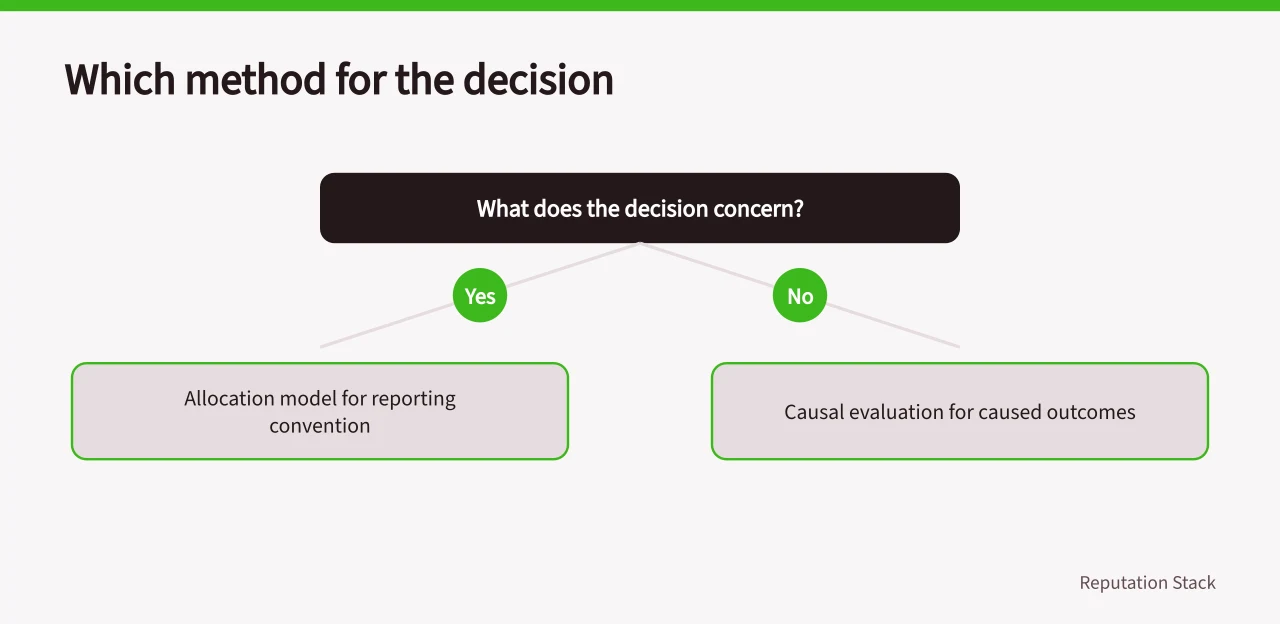
Use allocation models when the decision concerns a consistent reporting convention for recorded customer paths. Request a causal evaluation when a budget decision depends on additional outcomes caused by the intervention. More elaborate allocation does not automatically answer that second question.
Before commissioning analysis, ask for the outcome dictionary, eligible population, comparison logic, uncertainty treatment and planned sensitivity checks. Require a statement of what missing exposures prevent the analyst from concluding. Keep public responses, resolved complaints and completed purchases as separate event types throughout the work.
The review rules that frame the data
Review content is a regulated matter in the UK. The Competition and Markets Authority enforces consumer protection law against misleading review practices, and the Digital Markets, Competition and Consumers Act 2024 gives it direct enforcement powers over unfair commercial practices, including fake and misleading reviews. Advertising built on review ratings also falls under the CAP Code administered by the Advertising Standards Authority.
Record the compliance position beside the attribution record. A review the business cannot lawfully rely on is not an eligible event, however it appears in an export from Google Business Profile or Trustpilot.
Before you act
- Fix one outcome definition and one England branch population.
- Hold the eligible event set and lookback window constant.
- Record Google's direct-visit convention in both exports.
- Report incremental outcomes per eligible branch-week for causal designs.
- Ask for the outcome dictionary and comparison logic before commissioning.
- Keep complaints and purchases as separate event types.
- Keep review volume, average rating and response rate as separate units.
- Confirm the CMA and ASA position on the reviews in scope.
Common questions
Why can credit shares and incremental outcome rates not be compared directly?
They answer separate questions. A credit share divides a recorded total among channels; an incremental rate counts outcomes above a comparison trend. Match the unit and the question before placing them side by side.
What should an analyst check before treating a review exposure as a sales driver?
Check whether the recorded path contains that exposure. If it does not, treat the link as unproven and report it as a limitation rather than reassigning existing search credit.
When should a budget decision use a causal evaluation instead of an allocation model?
Use a causal design when the decision turns on outcomes the intervention caused. Use allocation when the decision only needs a consistent convention for recorded paths.