
Strategy
Part of A reputation management strategy for disputed reviews
Reputation management channel strategy for one case
A reputation management channel strategy for one fictional England case, comparing public replies, private follow-up and correction routes.
Choosing the right channel for one case starts with the case, not the platform. A reputation management channel strategy should match the communication to its job. This comparison uses one fictional England case: a public review disputes an appointment date and names a worker.
It compares Google Business Profile, Trustpilot, Facebook Page recommendations, X, and Care Opinion. It also covers the NHS website, TripAdvisor, and IPSO correction notices. No platform or live account was tested.
What to take away
- Match each reputation route to its proper jobpublic reply, private support, controlled correction or promotional reuse.
- Every route needs an owner, release version and accessibility check. It also needs a monitoring period, withdrawal action and archive reference.
- A public response can signpost private resolution but must not make redress conditional on silence.
- Adding promotional material to a service message can make it direct marketing under ICO guidance.
- Advertising a testimonial requires documentary evidence of genuineness, permission and substantiation of any claims.
One case, named channels compared
The common unit is one authorised case with its original review, disputed fact, complaint owner, proposed wording and correction route. The selection criteria are applied to the fictional facts rather than measured platform performance. The routes are compared without scores or a winner.
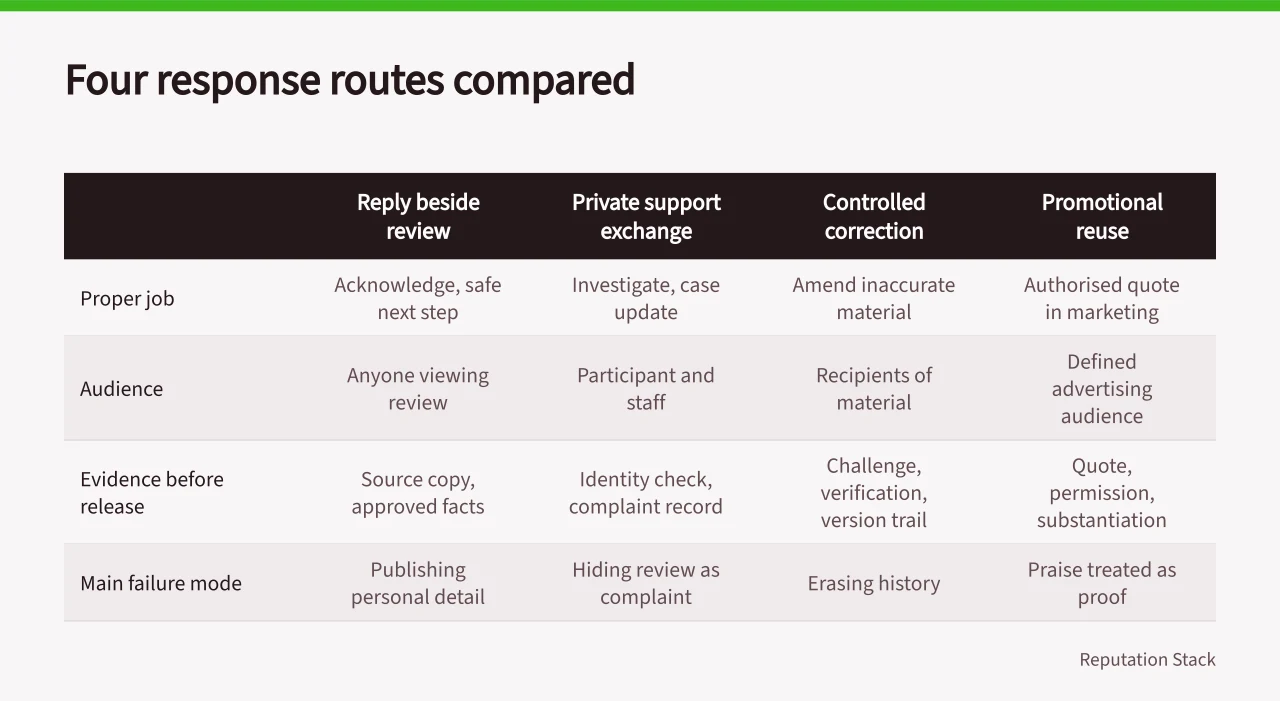
Proper job
- Reply beside the review
- Acknowledge and give a safe next step
- Private support exchange
- Investigate and provide a case update
- Controlled correction notice
- Amend inaccurate material the organisation controls
- Promotional reuse
- Use an authorised quotation in marketing
- Google Business Profile review reply
- Reply publicly to a Google review; flag policy breaches
- Trustpilot review reply
- Reply publicly to a Trustpilot review; flag for guideline breach
- Facebook Page recommendation reply
- Reply publicly to a recommendation; hide or delete comments on own posts
- X (Twitter) mention reply
- Reply publicly to a mention; move to DM only if the user allows
- NHS website / Care Opinion response
- Respond publicly to NHS or Care Opinion feedback
- TripAdvisor review reply
- Reply publicly to a TripAdvisor review; dispute policy breaches
- IPSO correction notice
- Seek a published correction for UK newspaper or magazine content
- Email or SMS private support
- Resolve the case one-to-one without a public reply
Audience
- Reply beside the review
- Anyone viewing that review
- Private support exchange
- Authorised participant and staff
- Controlled correction notice
- People who received or can access that material
- Promotional reuse
- Defined advertising audience
- Google Business Profile review reply
- Google users searching the business
- Trustpilot review reply
- Trustpilot users and search visitors
- Facebook Page recommendation reply
- Facebook users who see the Page
- X (Twitter) mention reply
- X users following the conversation
- NHS website / Care Opinion response
- Patients, carers and commissioners
- TripAdvisor review reply
- Travellers researching the business
- IPSO correction notice
- Readers of the original publication
- Email or SMS private support
- The reviewer or complainant only
Evidence before release
- Reply beside the review
- Source copy, approved facts, response authority
- Private support exchange
- Identity check, complaint record, secure contact route
- Controlled correction notice
- Challenge, verification, version trail, recipient map
- Promotional reuse
- Exact quote, permission, commercial interest, claim substantiation
- Google Business Profile review reply
- Owner verification, statement of facts, no personal data
- Trustpilot review reply
- Trustpilot account, review details, reply within 7 days for best practice
- Facebook Page recommendation reply
- Page admin role, recommendation text, no private case detail
- X (Twitter) mention reply
- X account, mention text, public reply draft
- NHS website / Care Opinion response
- NHS organisation login, feedback ID, approved response
- TripAdvisor review reply
- Owner centre login, review details, no guest personal data
- IPSO correction notice
- Complaint within 12 months, article details, proposed correction
- Email or SMS private support
- Lawful basis under UK GDPR and PECR, suppression check
Main failure mode
- Reply beside the review
- Publishing personal case detail or implying unverified certainty
- Private support exchange
- Hiding a genuine review by diverting it into a complaint
- Controlled correction notice
- Erasing history or failing to update another controlled copy
- Promotional reuse
- Treating praise as proof or concealing an incentive
- Google Business Profile review reply
- Public reply is indexable; recovery is edit or delete, but screenshots persist
- Trustpilot review reply
- Free plan limits replies; paid plans start at about £199 per month in 2026
- Facebook Page recommendation reply
- Recommendations can be turned off; deleted replies may still be seen in screenshots
- X (Twitter) mention reply
- Public replies are indexable; X Premium costs £8 per month in the UK as of 2026
- NHS website / Care Opinion response
- Care Opinion is free; NHS website responses need an NHS.net email or approved account
- TripAdvisor review reply
- Free owner replies; Business Advantage typically £200 to £400 per year as of 2026
- IPSO correction notice
- Free to complain; correction is published, but the original may remain online
- Email or SMS private support
- Low cost, typically included in business email or SMS bundles; no public recovery
The accessibility check covers colour contrast, keyboard access, alternative text for images and plain language. These common fields prevent a comparison based on reach or convenience alone.
Where reputation-management software fits
Reputation-management software can bring review monitoring, response workflows and reporting into a dashboard. Examples of vendors in this category include Birdeye, Podium, ReviewTrackers, Reputation.com, Yext and Brand24.
For this case, check whether a product supports the relevant review sites, integrations, user permissions, approval steps and audit history before adopting it. This is not a product comparison or live test: a software dashboard can organise work, but it cannot make a public response appropriate or amend a third-party review.
For each named channel, check the same fields. Google Business Profile and Facebook Page replies are public and indexable. Trustpilot and TripAdvisor replies are public on their own sites.
X replies are public and can be screenshotted. NHS website and Care Opinion responses are public to patients and commissioners. IPSO corrections are published but the original article may stay online. Email and SMS are private but need a lawful basis.
Public response is not complaint disposal
The CMA's review-site guidance says sites should distinguish reviews intended for publication from complaints and should not hinder genuine negative reviews. A public response can signpost private resolution, but the organisation should preserve both records and avoid making redress conditional on silence.
The public route carries the widest disclosure risk. Keep booking evidence and worker details out of the reply unless qualified reviewers approve a necessary and lawful use. If facts remain disputed, a short acknowledgement may be safer than a detailed rebuttal.
As a rule, choose a public reply first only if the review is published, the facts are settled and no personal data is needed. If the case needs investigation or individual details, start in private.
For the fictional case, a public reply might read: 'We are sorry to read this. We cannot discuss individual details here. Please email our complaints team so we can review the appointment record.'
Private contact can change classification
A neutral message about the existing complaint is different from a promotion. The ICO's direct-marketing identification guidance says content, purpose and context matter, and that adding promotional material can make a service message direct marketing.
Record the sender, recipient type, purpose and suppression check. Do not add an offer merely because the private channel is available. Email, text and social direct messages may engage channel-specific PECR questions that need qualified review.
Common private channels include email, SMS, and WhatsApp Business. X direct messages, Instagram direct messages, and Facebook Messenger are also common. Each may engage PECR.
Corrections need provenance
The ICO's accuracy principle guidance advises keeping the source and status of personal data clear and examining accuracy challenges. Link the amended record to the original, state what changed and notify the correct controlled destinations where required. A disagreement about opinion is not automatically a factual correction.
Controlled correction channels include your own website, Google Business Profile posts, and a published IPSO correction notice. IPSO handles complaints about UK newspaper and magazine content within 12 months.
Advertising adds a separate evidence burden
CAP's testimonials and endorsements advice says marketers should hold documentary evidence that a testimonial is genuine and should seek permission. It also says claims within testimonials must not mislead. The final advert, placement and qualification need review; the original review alone is insufficient.
Withhold the channel when a gate fails
Privacy and PECR, review integrity, and claim evidence are independent gates. Security, accessibility, IP, and recovery are also independent gates.
A route stays blocked if the organisation cannot correct it, withdraw it, control access or show what the audience will see. The result may be a private investigation with no public response. That is a channel decision, not a failure to manage reputation.
In the fictional case, the review disputes an appointment date on a third-party site. If the site allows replies but not edits to the original review, the correction gate fails. A public reply cannot amend the review text. The team withholds the public correction and directs the reviewer to email the complaints team for private follow-up.
Channel gate decision
Do all independent gates pass?
release the chosen route
keep route blocked, investigate privately
Before you act
- Confirm the route matches its proper job and audience.
- Record owner, release version, accessibility check and monitoring period.
- Check whether private contact adds promotional material.
- Link amended records to originals and notify controlled destinations.
- Hold documentary evidence and permission for any testimonial.
Common questions
What should a public reply beside a review achieve?
It should acknowledge the review and give a safe next step for anyone viewing it. The organisation should preserve both public and private records and avoid making redress conditional on silence.
When does private contact become direct marketing?
The ICO says content, purpose and context matter, and adding promotional material can make a service message direct marketing. Record the sender, recipient type, purpose and suppression check. Do not add an offer merely because the private channel is available. Email, text and social direct messages may raise channel-specific PECR questions.
What evidence supports a correction or an advert?
For corrections, keep the source and status of personal data clear, link the amended record to the original, state what changed and notify controlled destinations. For adverts, hold documentary evidence that a testimonial is genuine, seek permission and ensure claims within it do not mislead. The original review alone is insufficient.
Which named channels can carry a public reply?
Google Business Profile, Trustpilot, and Facebook Page recommendations all support public replies. X, the NHS website and Care Opinion, and TripAdvisor also support public replies. Each has its own flagging process for policy breaches.
Google Business Profile and Facebook are free. NHS website and Care Opinion responses are free. IPSO corrections are free to complain about UK newspaper or magazine content.