

Strategy
Part of A reputation management strategy for disputed reviews
Reputation management planning template for software
Use this reputation management planning template to assess review software: monitoring, response workflows, integrations, analytics and UK compliance.
Copy this reputation management planning template into a controlled document when assessing or implementing review and reputation-management software. Replace every bracketed field with buyer-owned evidence. The template applies to England and the wider UK, where UK GDPR, the Privacy and Electronic Communications Regulations (PECR) and CMA rules on online reviews set the legal scope. The template contains no sample results, budgets or deadlines.
Software assessment
Examples of review and reputation-management platforms to include in a buyer’s shortlist are Trustpilot, Yext, Birdeye and Reputation. This is not a ranking or a claim that every platform supports every capability; verify each requirement in the supplier’s current product materials, demonstration and contract.
For each candidate, record evidence for the review sources monitored and monitoring cadence; response assignment, approval, publication and correction workflows; analytics and reporting; and integrations with CRM or social systems where required. Note which data fields move between systems, the direction of transfer, permissions and how integration failures are handled.
Link each software claim to an evidence ID in the ledger. Record the supplier’s data-processing terms, access controls, retention, export and deletion arrangements, incident handling and exit process. Carry the chosen platform’s configuration and workflow into the synthetic rehearsal before production activation.
What to take away
- Empty bracketed fields are not permission to proceed, so every field needs buyer-owned evidence before you act.
- Record the source and status of personal data, and link any correction to the original record.
- Classify promotional wording separately from neutral service messages before publishing anything.
- Independent gates are recorded as pass, fail or unresolved, never as a weighted score.
Decision record
- Decision to be made
- [one action]
- England operating unit
- [legal entity and location rule]
- Case or workflow boundary
- [included task]
- Explicit exclusions
- [adjacent work not covered]
- Accountable decision owner
- [name and authority]
- Evidence cut-off
- [date and timezone]
- Recheck trigger
- [event]
- Final status
- [pass, fail or unresolved]
Example filled decision record:
- Decision to be made
- Whether to publish a public reply to a review alleging poor service.
- England operating unit
- Reputation Stack, England.
- Case or workflow boundary
- One review on a third party platform and the associated internal complaint record.
- Explicit exclusions
- Other reviews, marketing campaigns and product changes.
- Accountable decision owner
- Head of Customer Operations.
- Evidence cut-off
- 31 March 2025, 17:00 GMT.
- Recheck trigger
- New evidence from the customer or a platform policy update.
- Final status
- Unresolved.
Write the objective around a verifiable process, such as preserving source evidence and routing a factual challenge. Do not use star-rating movement as a substitute for a decision.
Decision record fields
- Decision to be made
- England operating unit
- Case or workflow boundary
- Explicit exclusions
- Accountable decision owner
- Evidence cut-off
- Recheck trigger
- Final status
Evidence ledger
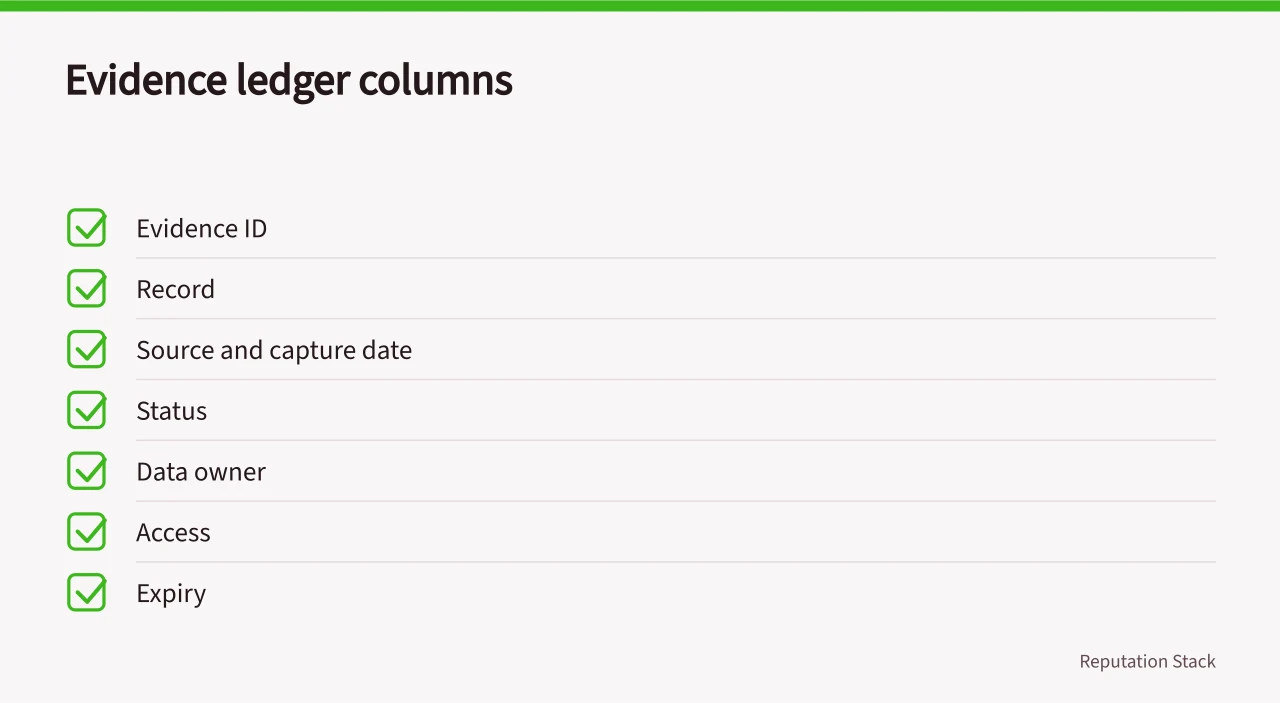
| Evidence ID | Record | Source and capture date | Status | Data owner | Access | Expiry |
|---|---|---|---|---|---|---|
| [ID] | [review, complaint, booking record or draft] | [origin] | [verified, disputed, opinion or unknown] | [owner] | [roles] | [date] |
| Example: EV-001 | Review on Trustpilot, 12 March 2025 | Trustpilot public page, captured 13 March 2025 | Verified | Complaints lead | Public, internal | 12 September 2025 |
The example row shows a completed ledger entry; it is not a real record.
The ICO's accuracy guidance (Guide to the data protection principles: accuracy) supports recording the source and status of personal data and considering challenges. Add a correction link between the original record and any amended state rather than silently replacing history.
Add a short rationale beside the ledger: [why this evidence can answer the decision], [which records are unavailable], [whose account is missing] and [what would contradict the current interpretation]. Name the person authorised to resolve each gap. A document's presence proves only that the file exists; it does not establish its accuracy, completeness or relevance to the final response.
Communication choice
- Communication class
- [public reply, private support, correction, service notice, advert or direct marketing]
- Intended recipient or public audience
- [population]
- Purpose
- [single purpose]
- Claims and evidence IDs
- [references]
- Personal data disclosed
- [fields or none]
- Channel and account owner
- [route]
- Approval version
- [ID]
- Monitoring and correction route
- [owner]
- Withdrawal or archive action
- [procedure]
If the message promotes the organisation, assess it separately. The ICO's identify direct marketing page (Direct marketing guidance: identify direct marketing) explains that genuine research or a neutral service message can be distinct from promotional content. The qualified reviewer must classify the actual wording and channel.
Communication choice fields
- Communication class
- Intended recipient or audience
- Purpose
- Claims and evidence IDs
- Personal data disclosed
- Channel and account owner
- Approval version
- Monitoring and correction route
Independent gates
Record each as pass, fail or unresolved, never as a weighted score.
- Review integrity and consumer evidence[reviewer, record, date]
- Factual and advertising claims[reviewer, record, date]
- Privacy, rights and PECR (ICO's Guide to PECR): [reviewer, record, date]
- Accessibility of the complete task[reviewer, method, date]
- Security, access and incident recovery[reviewer, test, date]
- IP, platform terms and permissions[reviewer, record, date]
- Supplier contract, export, deletion and exit[reviewer, record, date]
- Finance and approved cost[owner, source, date]
For review publication, attach the policy evidence required by the buyer's counsel. The CMA's guidance for online review sites (Reviews: guidance for online review sites) addresses genuine negative reviews, incentives, publication practices and commercial interests across the UK. Also assess the Digital Markets, Competition and Consumers Act 2024, which includes provisions addressing fake reviews.
Synthetic rehearsal
- Fixture version
- [ID]
- Invented records used
- [list]
- Tasks attempted
- [capture, challenge, approval, correction, objection, export, rollback]
- Observations
- [evidence IDs]
- Untested behaviour
- [list]
- Failure owner
- [name]
- Production activation
- [must remain off until approval]
Record the test environment and access list separately: [environment owner], [temporary users], [access granted], [revocation evidence] and [data-destruction record]. Do not paste a live complaint into the fixture. If the rehearsal cannot represent a sensitive case safely, test the state changes with wholly invented content and leave the content-specific decision unresolved.
Measure and stop card
- Eligible event[definition]
- Population[cases]
- Numerator and denominator or unit[blank until defined]
- Period and timezone[blank]
- Source query and version[blank]
- Threshold and approval evidenceFor example, a complaint rate above 5 per 1,000 eligible cases in a rolling 7 day period, approved by the Head of Customer Operations.
- Stop condition: For example, three unresolved factual challenges in one week, or any independent gate marked fail.
- Recovery evidence[record required before restart]
The completed plan may still end in a hold. That is the required result when an evidence field is missing or any independent gate fails.
Before you act
- Replace every bracketed field with buyer-owned evidence.
- Write the objective around a verifiable process, not star ratings.
- Add a correction link between the original record and any amended state.
- Record each independent gate as pass, fail or unresolved.
- Keep production activation off until approval.
- Leave the content-specific decision unresolved if the rehearsal cannot represent it safely.
Common questions
What should a decision record contain?
It lists the decision, the England operating unit and case boundary, explicit exclusions, the accountable owner, the evidence cut-off with timezone, a recheck trigger and a final status of pass, fail or unresolved. Write the objective around a verifiable process rather than star-rating movement.
How should a synthetic rehearsal handle a sensitive case?
Record the fixture version, invented records, tasks attempted, observations, untested behaviour, failure owner and keep production activation off until approval. If the rehearsal cannot represent a sensitive case safely, test state changes with wholly invented content and leave the content-specific decision unresolved. Do not paste a live complaint into the fixture.
What does the measure and stop card require?
It defines the eligible event, population, numerator and denominator or unit, period and timezone, source query and version, threshold and approval evidence, a stop condition and recovery evidence. The numerator, period, query and threshold stay blank until defined.