
Rules and ethics
Part of Reputation management UK rules: ethics and software checks
Review software for reputation management advertising rules
Keep review and reputation-management software records behind UK reputation management advertising rules: five pre-launch tickets, from capture to correction.
This operational check is for a final non-broadcast advert that uses a review, testimonial, star figure or reputation claim, and for the review and reputation-management software that holds the records behind it. Reputation management advertising rules in the UK turn on records as much as on wording. It was compiled on 6 September 2026 for an England operating context; a qualified UK advertising and consumer lawyer must review the actual page, placement and destination. The checklist is not a clearance certificate.
The rules map. Four sources apply across the UK:
- ASA and the CAP Code:the Advertising Standards Authority applies the non-broadcast Code to the overall impression of a marketing communication. The rules a review-led advert most often touches are 3.1 (misleading advertising), 3.7 (substantiation) and 3.45 to 3.47 (testimonials and endorsements).
- CMA:the Competition and Markets Authority enforces consumer protection law across the UK.
- DMCC Act 2024:the Digital Markets, Competition and Consumers Act 2024 gives the CMA direct enforcement over unfair commercial practices, including misleading reviews, from 6 April 2025.
- ICO and PECR:the Information Commissioner's Office enforces the Privacy and Electronic Communications Regulations, which cover cookies, tracking and electronic marketing.
What to take away
- This is a pre-launch checklist, not legal clearance.
- Save the rendered advert, destination page and disclosure under one version number before any review appears.
- Testimonials alone rarely prove objective claims, so separate opinion from substantiated performance messages.
- Collection, moderation and incentives all affect whether a review gives a misleading overall impression.
- Release stops if any required ticket remains unresolved, even when every other item passes.
- A platform's removal of one post does not show syndicated copies or paid placements have changed.
- A review dashboard is a working copy; the dated export from the platform is the record.
Where the evidence lives: review and reputation software
Most of these tickets fail on missing records rather than on wording. The records sit in the review platform that published the comment — Trustpilot, Google Business Profile, Feefo, Reviews.io and Facebook recommendations are the ones most UK advertisers deal with — and in the reputation-management tools that pull those comments into one dashboard, such as BrightLocal, Brand24 and ReviewTrackers.
Whichever stack you use, three exports matter before launch:
- the original review text, star rating and publication time exactly as the platform holds it;
- the invitation, incentive and moderation records for that review, including any review-gating settings;
- a dated copy of the derived score, ordering, badge or widget that the advert shows.
Keep those exports with the version number from Ticket A. A dashboard entry is a working copy, not the record: if a platform later removes or edits a review, the export shows what the audience saw.
Each ticket also has a software home. Ticket A sits in the creative archive and the landing-page system; Ticket B in the review platform's invitation, incentive and moderation records; Ticket C in the file that substantiates the widget, badge or score the advert shows; Ticket D in the collection, ordering and review-gating settings; and Ticket E in the tracking, consent and publishing tools that push the claim out. If your review or reputation software cannot export one of these, the ticket fails on evidence before it fails on wording.
Ticket A: capture what the audience receives
- Save the rendered advert, headline, image, disclosure, link and destination page under one version number.
- Name the advertiser, promoted product, intended audience, territory and planned release time.
- Write the likely factual impressions beside the exact words or design elements that create them.
The CAP Code's misleading-advertising rules — 3.1 on misleading communications and 3.7 on substantiation — say the ASA judges a communication's overall impression, not isolated phrases, and that the advertiser must hold evidence for its claims. The Code is self-regulatory material for non-broadcast marketing. Counsel must also examine applicable legislation and sector rules.
Ticket A: capture the advert
- Save rendered advert, headline, image, disclosure, link, destination
- Name advertiser, product, audience, territory, release time
- Write likely factual impressions beside exact words or design
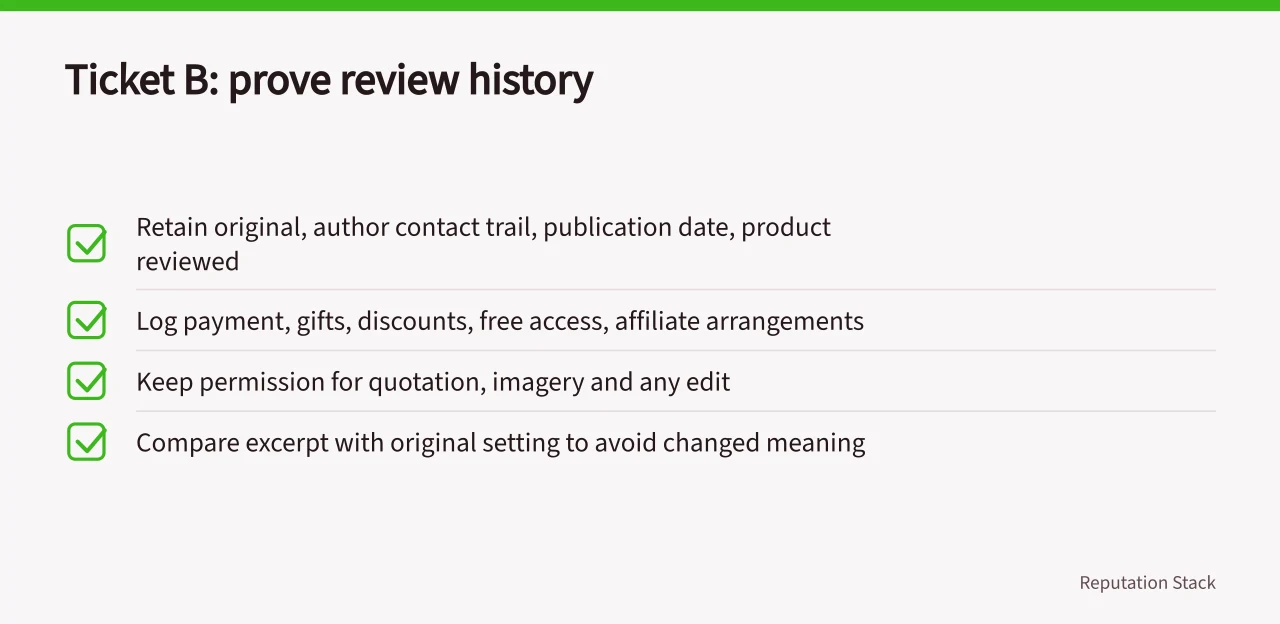
Ticket B: prove the review's history
- Retain the complete original, author contact trail, publication date and product or service reviewed.
- Log payment, gifts, discounts, free access, affiliate arrangements, employment, directorship or investment.
- Keep permission for quotation, imagery and any edit.
- Compare the excerpt with its original setting so that cropping does not change the meaning.
CAP Code rules 3.45 to 3.47 govern testimonials and endorsements, and CAP's testimonials and endorsements advice, issued 31 July 2026, discusses documentary proof of genuineness, contact details, relevance and commercial interests. It is CAP Executive advice, not legal advice, and does not bind the ASA.
Ticket C: substantiate the advertiser's implication
- Separate personal opinion from claims about results, savings, quality, speed, prevalence or superiority.
- For each objective proposition, attach evidence that matches the advertised service, population, geography and period.
- Remove or narrow any statement whose evidence is absent, outdated or methodologically incompatible.
The CAP Executive's substantiation page was updated 12 March 2026. It explains that testimonials alone are unlikely to prove objective claims. A genuine comment can therefore remain unusable for a broader performance message.
Worked illustration: an advert crops a five-star review to a phrase about speed and places it beside a next-day delivery claim. In the original setting the reviewer described a refund. Ticket B fails because the crop changes the meaning; Ticket C fails because no delivery data backs the claim.
Ticket D: examine collection and presentation
- Confirm whether the review was solicited and which invitation rules applied.
- Show incentives clearly; do not commission or supply fabricated praise.
- Check that moderation, ordering and derived scores do not give a misleading picture.
- Keep service complaints distinct from publishable reviews and do not condition help on silence.
The CMA's review-site guidance, published 3 September 2025, addresses collection, checking, negative reviews and commercial relationships, and the CMA's guidance on hidden ads covers paid endorsements that are not clearly labelled. The statutory background is the DMCC Act regime applying to relevant commercial practices from 6 April 2025. Conduct that began before that date is judged under the Consumer Protection from Unfair Trading Regulations 2008, which the DMCC Act regime replaced.
Ticket E: release and reversibility
- Send tracking pixels, direct messages and uploaded audiences through separate privacy and PECR review.
- Test the disclosure and complaint route using keyboard, zoom and screen-reading workflows.
- Name the person who can pause spend, correct every controlled copy and preserve the former version.
- Set an evidence expiry and a trigger for rechecking law, code, incentive, claim or placement.
Open a correction ticket before launch rather than improvising after a complaint. It should identify every controlled location where the claim will appear, including scheduled posts, creative libraries and agency accounts. Record who can stop publication, how the former version will be retained, and what proof will show that a correction reached each copy.
If the review author withdraws permission or the underlying evidence changes, pause spend and raise a correction ticket assigned to the advertising counsel.
Record each ticket as pass, fail or unresolved. Consumer integrity, advertising, privacy, PECR, IP, accessibility and security are independent.
Before you act
- Freeze the version number and timestamp before the first post goes live.
- Log payment, gifts, discounts, affiliate arrangements and commercial interests.
- Get the reviewer's written permission for the exact crop, quote and image.
- Confirm in writing who can pause spend, who corrects each controlled copy and when the evidence expires.
Common questions
What must a lawyer review before this checklist is treated as clearance?
A qualified UK advertising and consumer lawyer must review the actual page, placement and destination. The checklist is not a clearance certificate, and counsel must also examine applicable legislation and sector rules beyond the self-regulatory CAP Code.
Why can a genuine review still be unusable for a performance claim?
The CAP Executive's substantiation page, updated 12 March 2026, explains that testimonials alone are unlikely to prove objective claims. A genuine comment can therefore remain unusable for a broader performance message unless separate evidence matches the advertised service, population, geography and period.
What should happen if the review author withdraws permission?
The correction ticket should go to the advertising counsel, the consumer law adviser and the IP solicitor. Record who can stop publication, how the former version is retained, and what proof shows a correction reached each controlled copy, including scheduled posts and agency accounts.